A new real estate lead rarely arrives with everything you need.
You may get a name, an email address, a property inquiry, and one sentence that says, "I would like more information." The lead could be ready to tour this week, researching a move next year, asking for a family member, or simply trying to understand the market.
The problem is not that the lead is unqualified. The problem is that the record is incomplete.
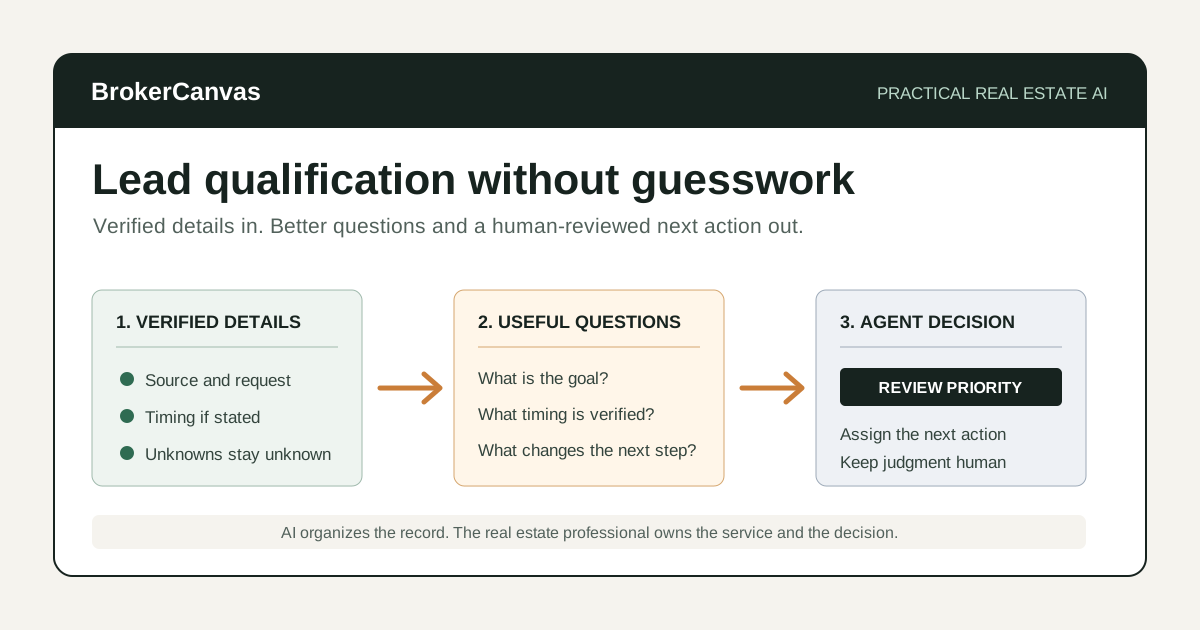
AI lead qualification for real estate agents can help organize what the person actually said, show what is still unknown, prepare useful questions, and create a consistent follow-up priority. It should not decide who deserves a response or make guesses about income, motivation, identity, financing, or seriousness.
My rule is simple: use AI to find the next useful question, not to pass judgment on the person.
What Lead Qualification Should Mean in Real Estate
Lead qualification is often described as separating good leads from bad leads. I do not think that is a useful starting point.
A better definition is: collecting enough verified information to understand the person's goal, timing, next step, and service needs.
For a buyer, that may mean learning what they are trying to accomplish, where they are in the process, whether they want lender guidance, and what kind of property conversation would help. For a seller, it may mean understanding the property, timing, decision stage, and reason for reaching out. For a referral or past client, the existing relationship may matter more than any score.
A lead can have a long timeline and still be worth serving well. A lead can sound urgent and still need basic education before an appointment makes sense. Qualification should improve the conversation, not become an excuse to ignore people.
Where AI Helps With Real Estate Lead Qualification
AI is useful when inquiry details are spread across a form, text thread, email, CRM note, and call recap.
It can help:
- summarize only the facts the lead provided
- separate known information from assumptions
- identify unanswered intake questions
- organize buyer, seller, investor, renter, referral, or unknown intent
- prepare a short first-response draft
- suggest the next useful conversation goal
- create a consistent CRM note
- apply transparent team priority rules
- flag records that need immediate human review
The value is consistency. Every lead gets a thoughtful next step even when the original inquiry is thin.
What AI Should Not Decide
This is where lead scoring can become careless.
Do not let AI:
- infer race, color, religion, sex, disability, familial status, national origin, or another protected characteristic
- use a name, language pattern, neighborhood, ZIP code, photo, accent, or family detail as a proxy for identity or value
- guess income, creditworthiness, financing approval, citizenship, or ability to purchase
- label someone unserious because their timeline is long or their message is brief
- decide who receives faster, better, or more complete service based on an opaque score
- invent motivation, urgency, budget, property facts, or relationship history
- provide lending, legal, tax, appraisal, fair housing, or investment advice
If a score cannot be explained in plain language from verified, business-relevant facts, I would not use it.
Follow your brokerage policy, fair housing obligations, privacy rules, advertising rules, CRM permissions, and local requirements. The agent or team remains responsible for the service provided.
A Practical AI-Assisted Lead Qualification Workflow
Step 1: Capture the original inquiry without rewriting it
Save the source, timestamp, property or page involved, exact message, contact preference, and any prior relationship.
Do not clean up the record so aggressively that the lead's actual words disappear. The source message matters because it shows what the person asked and what they did not ask.
Step 2: Separate known facts from unknowns
Create two lists.
Known: details the lead explicitly provided or the agent verified.
Unknown: information that may help determine the next step but has not been confirmed.
For example, a buyer may mention a specific home and a weekend showing request. Their financing status, broader search criteria, agent relationship, and timeline may still be unknown. Do not let AI fill those blanks.
Step 3: Identify the next conversation goal
The first response does not need to complete an intake interview.
Choose one useful goal:
- answer the property question
- confirm whether the lead is already represented
- schedule a short call
- learn the buyer's timing and search stage
- learn the seller's property and decision stage
- connect the person with an appropriate lender or other professional when requested
- clarify what kind of information would be most helpful
A good first response moves the conversation one step. It does not interrogate the lead.
Step 4: Ask only the questions that change the next step
I would rather ask three useful questions than send a ten-question form no one wants to finish.
Useful buyer questions may include:
- Are you interested in this specific property or comparing a few options?
- What timing are you working toward?
- Are you already working with an agent?
- Would lender guidance be useful, or do you already have that part handled?
- What would make the next conversation most useful?
Useful seller questions may include:
- What property are you considering selling?
- What prompted you to start looking into the move?
- Is there a timing goal or is this early research?
- Have you made any major updates that would help with the market review?
- Would a short planning call or a property visit be the better next step?
Questions should be relevant to the service, consistently applied, and reviewed for fair housing and brokerage compliance.
Step 5: Apply a transparent priority framework
Priority is not personal worth. It is the order in which operational tasks need attention.
A simple framework can use:
- Response need: Is the person waiting on a direct answer, showing request, or scheduled action?
- Timing: Did the person provide a verified near-term deadline or appointment request?
- Specificity: Is there a specific property, market question, or service request?
- Relationship: Is this a past client, referral, or existing active conversation?
- Completeness: Is enough information available to take the next step, or should the first task be clarification?
None of those factors should reduce the basic quality of service. They simply help the agent decide which task should happen first.
Step 6: Have the agent review the summary and priority
Before any message is sent or task is assigned, check the source.
Ask:
- Did the summary preserve what the lead actually said?
- Did AI turn an unknown into a fact?
- Is the proposed question necessary and appropriate?
- Can the priority be explained without using a protected or proxy characteristic?
- Would I be comfortable explaining this process to the client or my broker?
This review is not busywork. It is what keeps a useful intake system from becoming an unaccountable scoring system.
Step 7: Save the next action, not just the score
A score by itself does not move a lead forward.
The CRM record should end with:
- verified intent
- known timing
- open questions
- assigned owner
- next action
- due time
- follow-up cadence if the lead does not respond
The next action is the useful output. The score is only a supporting label.
Example Prompt: Organize and Qualify a New Real Estate Lead
Use only information your brokerage permits you to process. Remove unnecessary personal data and review the output before saving or sending anything.
You are helping a real estate agent organize a new lead inquiry.

Role:
Act as an intake and workflow assistant. Use verified details to prepare the next conversation. Do not judge the person's worth, intent, financial ability, or likelihood of closing.

Original inquiry:
[paste the permitted inquiry text]

Verified CRM context:
- Lead source:
- Date and time received:
- Property or page involved:
- Existing agent or team relationship:
- Prior conversation notes:
- Communication preference:

Business rules:
- Response standards:
- Assignment rules:
- Priority definitions:
- Required intake questions:
- Brokerage or compliance rules:

Guardrails:
- Use only the information provided.
- Do not infer protected characteristics or use proxy information.
- Do not guess income, credit, financing, citizenship, motivation, urgency, budget, or representation status.
- Do not provide legal, tax, lending, appraisal, fair housing, inspection, or investment advice.
- Do not label the lead good, bad, serious, unserious, qualified, or unqualified.
- If information is missing, mark it unknown.
- Explain every priority recommendation using verified operational facts.
- A real estate professional will review the output.

Create:
1. A concise summary of verified facts.
2. A separate list of unknown or missing information.
3. The most useful goal for the next conversation.
4. Up to three intake questions that would change the next step.
5. A response priority based only on the business rules provided.
6. A plain-language explanation of that priority.
7. A first-response draft under 120 words.
8. A CRM note with owner, next action, and due time.
9. Any fair housing, privacy, or professional-review concern to check.
Example Prompt: Review a Lead Scoring Framework for Bias and Overreach
If your CRM or team already uses lead scores, review the rules before asking AI to apply them.
Review this real estate lead priority framework for clarity, consistency, and potential overreach.

Current scoring or priority rules:
[paste rules]

Lead sources covered:
[list sources]

Intended use:
[task order / agent routing / follow-up cadence / reporting]

Rules:
- Do not provide a legal compliance conclusion.
- Flag any factor that could use or approximate a protected characteristic.
- Flag vague factors such as "quality," "fit," "good area," "seriousness," or "likely buyer."
- Flag any factor that asks the system to guess financial capability, motivation, identity, or future behavior.
- Separate service priority from judgments about the person.
- Preserve equal access to accurate, complete, and respectful service.

Return:
1. Rules that are clear and operational.
2. Rules that need a clearer definition.
3. Rules that should be removed or reviewed with the broker or qualified counsel.
4. A simpler transparent priority framework.
5. A human-review checklist.
6. Questions leadership should answer before implementation.A Simple Real Estate Lead Qualification Scorecard
I would call this a priority scorecard, not a prediction score. It should organize work without pretending to forecast who will close.
1. Direct response needed
Is the person waiting on an answer, showing request, appointment confirmation, or other time-sensitive action?
2. Verified timing
Did the lead state a real deadline or timeframe, or is timing still unknown?
3. Specific request
Is there a clear property, market, selling, buying, or planning question the agent can address?
4. Existing relationship
Is this a current client, past client, referral, or active conversation that should remain with the existing agent?
5. Next-step readiness
Is the next action clear, or does the agent need one clarification first?
Use a small scale, such as 0 to 2 for each factor. Keep the definitions written beside the score. Review exceptions manually. Do not turn the total into a promise of conversion.
How Lead Qualification Connects to Follow-Up and Routing
Qualification, routing, and follow-up solve different problems.
- Qualification organizes known facts and identifies the next useful question.
- Routing decides who owns the response based on written team rules.
- Follow-up defines what happens after the first conversation.
Use the lead routing workflow for small real estate teams when ownership is unclear. Use the real estate CRM follow-up workflow to turn the intake record into an actual sequence. Use the 30-day AI lead follow-up cadence when the lead does not respond immediately. Use the real estate AI compliance checklist before adopting scoring or automation rules.
For open-house inquiries, the open house follow-up workflow shows how to organize visitor notes without inventing motivation. For older records, use the stale lead reactivation workflow instead of treating an old score as current truth.
Team Rules Worth Writing Down
If more than one person handles leads, document:
- which facts may be used for priority and routing
- which factors are prohibited
- how unknown information is labeled
- who reviews AI-generated summaries
- how quickly each lead source receives a response
- how existing relationships override rotation
- what happens when a score and agent judgment disagree
- how clients can correct inaccurate information
- how long intake data and AI outputs are retained
This is the kind of workflow where a short, clear SOP is more valuable than an elaborate automation diagram.
Lead Qualification Review Checklist
Before using an AI-generated lead summary or priority, check:
- Can every fact be traced to the inquiry or verified CRM history?
- Are unknown details still marked unknown?
- Did the system infer motivation, identity, finances, or representation?
- Are the intake questions necessary for the next service step?
- Can the priority be explained using written operational rules?
- Does every lead still receive accurate and respectful service?
- Has the agent reviewed the response before it is sent?
- Is the next task clear, assigned, and timed?
If the score is sophisticated but the next action is vague, the workflow is not finished.
The Best First Step
Start with ten recent leads from one source.
Hide unnecessary personal information. Write down the facts you actually needed to determine the next conversation. Then compare those facts with the fields, questions, and scores your current system uses.
You will probably find that a few simple details matter and several existing fields do not.
Build the first workflow around those useful details. Test it manually before automating it.
Final Takeaway
AI can help real estate agents organize lead details, identify missing information, prepare better questions, and apply consistent operational priorities.
It should not decide who is worthy of attention, guess protected or financial information, or predict a person's value from thin data.
The practical goal is not to eliminate judgment. It is to give the agent a cleaner record and a better next conversation.