Most stale lead follow-up fails because it sounds like stale lead follow-up.
"Just checking in."
"Are you still looking?"
"Let me know if you need anything."
Those messages are easy to send. They are also easy to ignore.
A better stale lead reactivation workflow starts with context. Why did the person reach out? What were they trying to solve? What changed since the last conversation? What useful reason do you have to contact them now?
AI can help with stale lead reactivation for real estate, but only if you feed it real notes and make it find a useful angle. If you ask it to "write a follow-up email," it will usually produce the same generic message your lead has already seen from five other agents.
The win is not reviving every old lead. The win is sending a follow-up that has a reason to exist.
The Right Way to Think About Stale Lead Reactivation
A stale lead is not automatically a bad lead. Sometimes the timing changed. Sometimes financing was not ready. Sometimes the buyer paused. Sometimes a seller got busy. Sometimes the last follow-up was weak and the conversation simply faded.
The mistake is treating every old lead the same.
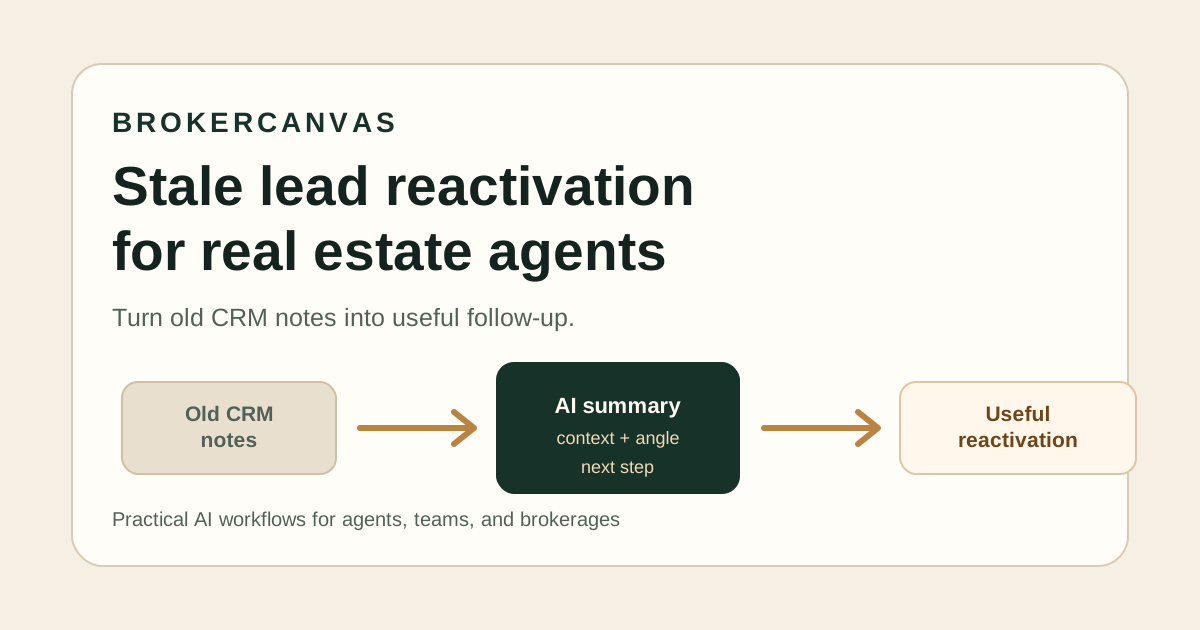
AI is useful because it can help summarize old CRM notes, group leads by situation, draft a message based on the actual context, and create a next task. It should not invent motivation, pretend the person is ready, make pricing claims, or pressure someone who clearly paused.
The agent still owns the judgment.
What AI Can Help With
Use AI to reduce the blank-page work and clean up the thinking.
- summarizing old CRM notes
- sorting stale leads by buyer, seller, investor, referral, past client, or unknown
- identifying why the conversation stalled
- suggesting a useful reactivation angle
- drafting a short email, text, or voicemail script
- creating a CRM task and follow-up cadence
- flagging missing information before you send
That is the practical use case. AI helps you stop staring at old notes and start with a sharper next step.
What AI Should Not Do
Do not use AI to mass-blast every stale lead with the same message. Do not let it invent market facts, financing assumptions, family status, urgency, budget, motivation, or life changes.
Be especially careful with fair housing-sensitive language, financing statements, pricing claims, market predictions, and anything that sounds like legal, tax, lending, appraisal, or inspection advice.
AI can draft. You review. That rule does not change just because the lead is old.
A Practical Stale Lead Reactivation Workflow
This is the simple version I would build first.
Step 1: Pull a small list
Do not start with your entire CRM. Pull 25 to 50 stale leads from one category:
- buyer inquiries from 90 to 180 days ago
- seller valuation requests that went quiet
- open house visitors who never booked a follow-up
- old relocation conversations
- past clients who asked a real estate question last year
Small lists force better review. A giant export usually turns into a generic campaign.
Step 2: Summarize what happened
For each lead, summarize the last known context:
- why they reached out
- what they wanted
- where the conversation stalled
- what was promised or sent
- what may have changed since then
- what you should verify before contacting them
If the notes are thin, say that. Do not ask AI to fill in missing facts.
Step 3: Choose the reactivation angle
A stale lead message needs a reason. Good angles include:
- a fresh market snapshot
- new listings that match old criteria
- a pricing or prep update for a seller
- a helpful relocation checklist
- a change in inventory or concessions
- a simple "should I update your search?" question
- a useful homeowner check-in for a past client
The angle should connect to what the person cared about before. If it does not, the message will feel random.
Step 4: Draft one email and one text
Keep the first message short. The goal is to reopen a conversation, not explain everything you know.
A useful stale lead message usually has:
- one sentence of context
- one useful reason for reaching out
- one low-pressure question
- one clear next step
Step 5: Create the next CRM task
The task should be specific. "Follow up" is not enough.
Better tasks look like:
- send three updated listing options Friday morning
- check whether seller wants a refreshed pricing snapshot next week
- text relocation buyer after lender intro
- send market update if no reply in seven days
This is where reactivation becomes a workflow instead of a one-off message.
Example Prompt: Stale Lead Reactivation
Use this after removing unnecessary private details from your notes.
You are helping me reactivate stale real estate leads from my CRM.

Role:
Act as a practical real estate follow-up assistant. Use the notes I provide to summarize the lead, identify a useful reactivation angle, and draft a short follow-up.

Guardrails:
- Do not invent motivation, budget, timeline, financing, property facts, family status, or life changes.
- Do not make pricing, market, legal, tax, lending, appraisal, inspection, or investment claims.
- Do not use fair housing-sensitive language.
- Avoid generic "just checking in" language.
- Keep the tone calm, useful, and low-pressure.
- The agent will review before sending.

Lead context:
- Lead type: [buyer / seller / investor / past client / referral / unknown]
- Source:
- Last conversation date:
- What they originally wanted:
- Property, area, or price point mentioned:
- Timeline if known:
- Objections or concerns:
- Last message sent:
- Why the conversation stalled:
- Current market or inventory note I can verify:
- What I want the next step to be:

Requested output:
1. One-sentence lead summary.
2. Likely reason the conversation stalled, with uncertainty noted.
3. Best reactivation angle.
4. Email under 160 words.
5. Text message under 320 characters.
6. Voicemail script under 45 seconds.
7. CRM note.
8. Specific next task and due date.
9. Facts I should verify before sending.
Five Stale Lead Message Templates
Use these as starting points. Replace the placeholders with real context.
1. Buyer who paused the search
Hi [Name], I was looking back at our conversation about [area/property type]. Since inventory has shifted a bit since then, I wanted to ask whether you still want me to keep an eye on homes like that or if your timing has changed. Happy to update the search either way.2. Seller valuation lead
Hi [Name], I was thinking about your question from earlier this year about [property/neighborhood]. If selling is still on the radar, it may be worth refreshing the numbers with recent activity rather than relying on the old snapshot. Want me to update that for you?3. Open house visitor
Hi [Name], you stopped by the open house at [property] a while back, and I wanted to send a more useful follow-up than a generic check-in. Are you still watching homes in that area, or did your search move in a different direction?4. Relocation buyer
Hi [Name], I know timing can change quickly with a move. If [market] is still on your list, I can send a short update on what buyers are seeing right now so you have a current starting point. Would that help?5. Past client homeowner
Hi [Name], I hope you are doing well. I wanted to send a homeowner note, not a sales pitch. If you are planning any updates this year, I am happy to be a sounding board on which projects may matter most for future resale and which are more about personal enjoyment.How to Build a Simple Reactivation Cadence
Do not build a complicated drip sequence first. Build a short cadence that feels human.
- Day 1: send the context-based reactivation email and text
- Day 4: send one useful resource, listing, market note, or question
- Day 10: ask whether they want updates paused, adjusted, or continued
- Day 30: move them into the right nurture path if there is no response
The key is to make each touch useful. If all four messages say the same thing, stop and rewrite the workflow.
Where This Fits in BrokerCanvas Workflows
Stale lead reactivation sits inside the broader follow-up system. Use the real estate CRM follow-up workflow to clean up notes and next tasks. Use the lead routing workflow if a team needs clearer ownership. Use the seller nurture templates when the stale lead is a homeowner thinking about selling.
If your follow-up system is inconsistent across a team, the AI Readiness Audit can help identify whether the issue is notes, routing, prompts, CRM habits, or training. If you want a deeper personal system, the full BrokerCanvas training is the better path.
The Best First Step
Pull 25 old leads from one source. Do not touch the whole database yet.
For each lead, write three bullets: what they wanted, why they paused, and what would make a follow-up useful now. Then use AI to draft one short email and one text.
Review every message before sending. Remove anything generic. Remove anything invented. Keep the next step clear.
Final Takeaway
Stale lead reactivation does not need to sound desperate. It needs to sound useful.
AI can help you turn old CRM notes into better follow-up, but it cannot replace the reason for reaching out. Start with context. Pick a useful angle. Keep the message short. Make the next step easy.
That is how old leads become real conversations again.